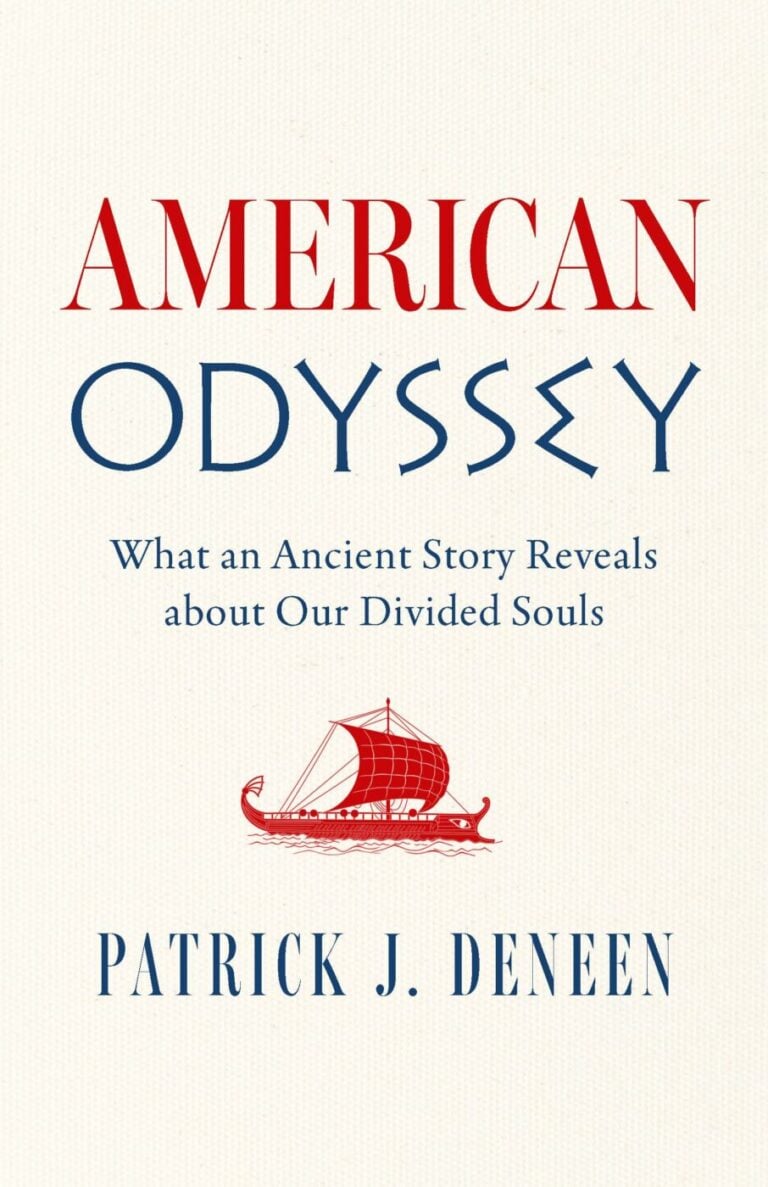
Adam Smith’s insightful article and review of Patrick J. Deneen’s new book, American Odyssey in Front Porch Republic

An Excerpt from Front Porch Republic…
I read American Odyssey with delight. It’s written for a broader audience than Odyssey of Political Theory, and Deneen clearly enjoys placing his love for the Odyssey in conversation with great works of American literature and film. The core idea is that the figure of Odysseus, and the story Homer tells about him, is about a tension at the heart of the human condition. Odysseus wants to go home, but he doesn’t only want to go home. As much as he’s the symbol of nostos (homegoing), he’s also the great explorer. The Odyssey is about the conflict between the desire to explore and the desire to settle, the drive for adventure and the love for peace and quiet, the faith that limits are made to be broken and the conviction that limits are sources of strength. And for Deneen, this is a story whose “tensions are perhaps more present in the American soul than in any other.”
The argument of the book is that everything depends, for persons as well as for political communities, on keeping the Odyssean tension from collapsing into one pole or the other. The character of Odysseus, in Deneen’s telling, is special because in him the love for home and the pull of the frontier are in conflict, but the conflict is not an error. It is not the result of a logical or moral contradiction that can or should have been avoided. It is, rather, a part of being human that we want both things. And because of our history and temperament, Americans want both things with special intensity. The Odyssey “disclose[s] a profound truth about Americans’ divided souls: We are at once creatures who settle and creatures who seek more. . . . In this dualism, we Americans are like all humans. Yet in a particularly powerful way, this dualism is a constitutive aspect of American character” The story of Odysseus can call us back to this aspect of ourselves, to this tension which has at various times been unbalanced by the elevation of one pole over the other.
Deenen develops his idea by exploring the Odyssean tension in several works from the American mythos: The Wizard of Oz (“somewhere over the rainbow” leads to “no place like home”); Huckleberry Finn (like Odysseus, Huck would rather die and go to hell than betray his friends and earn salvation from death); Field of Dreams (Doc Graham chooses the heroism of civic commitment to particular people over Achillean greatness in the halls of fame); and It’s a Wonderful Life (George Bailey, consumed by the ambition to get out, discovers the beauty of staying put). Set in conversation with the Odyssey, Deneen’s readings of these vital stories are deeply satisfying and often fresh (Bailey, for example, is not quite the localist hero we all take him to be). Combined, they carry the reader home to a concluding chapter that makes a brief but compelling—and perhaps surprising—argument about what kind of politics we need for our time.