Dr. Juliana Geran Pilon author of Notes from the Other Side of Night: From Communism to a Fragile Freedom examines the current socialist movement.
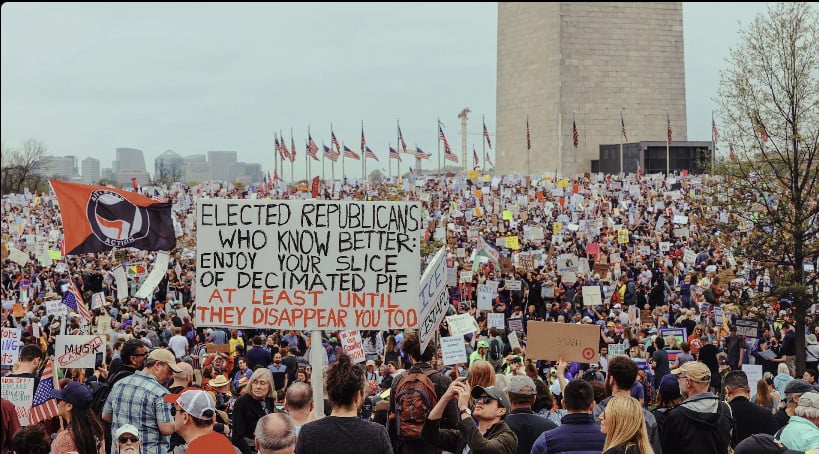
What accounts for the meteoric rise of the Democratic Socialists of America (DSA)? The punditry is at wit’s end. The group’s size alone would relegate it to irrelevance: the membership of over 120,000, its highest ever (up from only a few thousand not long ago), still represents no more than .003 percent of the total population. And the bizarre Bolshevist platform that Wall Street Journal columnist calls “mostly fertilizer for the feeble-minded.” Yet his colleague warns that “Socialists May Prove Surprisingly Strong in November.”
Maybe that’s just the point: the DSA was meant to surprise.
This Trojan horse, self-labeled a registered 501 (c)4 nonprofit “movement,” is a politically ingenious cog in a wider machine modeled on early twentieth century prototypes. Designed to adapt as circumstances evolve, it grows by accessing a variety of funding sources, both domestic and foreign. Over the years, DSA and its partners-in-subversion have trained a wide cadre of activists, who in turn learned how to mobilize and coordinate disparate constituencies. These have both increased and diversified in recent years in a far more militant, violent direction.
DSA’s very name is a decoy. To paraphrase Voltaire’s (1756) about the Holy Roman Empire being neither Holy, Roman, nor an Empire, DSA is as “Democratic” as North Korea, and “of” America refers to its target, not its spirit. Only “Socialists” reveals what the Union of Socialist Republics shared with Hitler’s National Socialist Workers Party: a cadre in charge of a centrally controlled economy and thought. Read
Established in 1982 under the leadership of radical historian Michael Harrington, DSA’s first big event, sponsored by its City University of New York chapter, was a Socialist Scholars Conference (SSC) held in October 1983, marking the centennial of Karl Marx’s death. In attendance was a young Columbia University student who had just transferred from Occidental College in Los Angeles named Barack Hussein Obama. The experience proved life-changing in ways that were understood only two decades later.