Patrick Deneen’s American Odyssey reviewed in First Things
Who is our Odysseus? Or more precisely, who is the most Odyssean hero of American film? Matt Damon’s mopey trauma patient? Certainly not. Luke Skywalker, perhaps? No, too obnoxious and too chaste—an incel turned jihadist. John Wayne? Maybe, but I’d need to rewatch his oeuvre to know which character—they all run together—and my wife hates Westerns. Rather, I suggest the true American avatar of Odysseus—that man of many turns, slayer of monsters and concubine of goddesses—is hiding in the holiday section: Clark Griswold, as played by Chevy Chase in National Lampoon’s Christmas Vacation.
Consider Clark Griswold—now there’s an Odyssean hero! Polutropos indeed, a man of so many turns: Cleaver of trees, Apollonian illuminator of suburban palaces, and clever inventor of the non-nutritive cereal varnish, Clark seduces the Calypso of a lingerie counter, sacks a yuppie citadel, and abducts a pajamaed god—but all for the love of hearth and home and family, all for the sake of “the hap-hap-happiest Christmas since Bing Crosby tap-danced with Danny f***in’ Kaye!” And what a denouement! Wild beasts and faithless uncles burned alive, broken crockery and rabid dogs, and, at the end, the heroic island king stands unbowed, clutching his wife, bankrupt but defiant before an armada of drawn guns. That sounds like Homer to me:
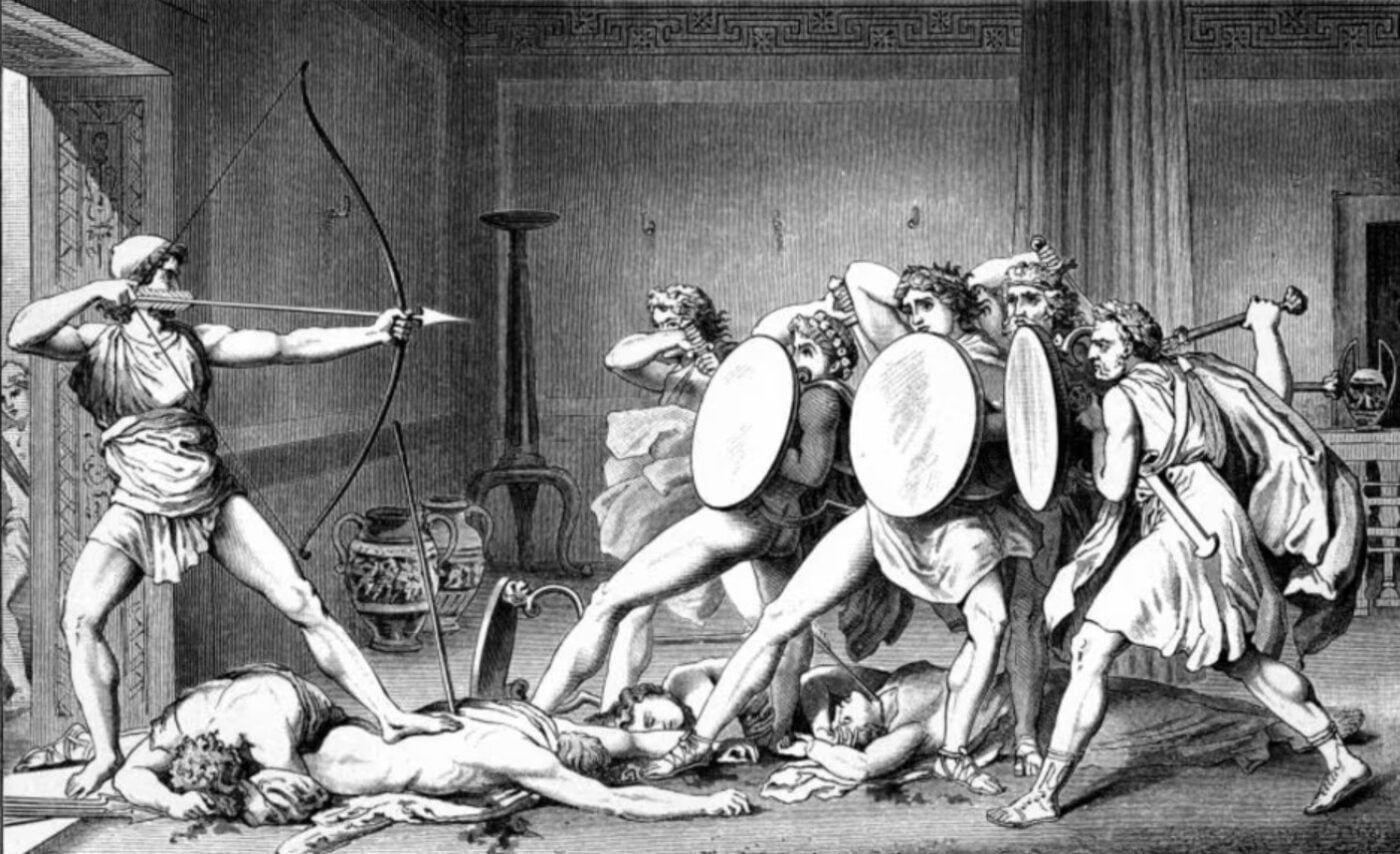
I found Odysseus in the thick of slaughtered corpses;
there he stood and all around him, over the beaten floor,
the bodies sprawled in heaps, lying one on another . . .
How it would have thrilled your heart to see him—
splattered with bloody filth, a lion with his kill!
I know that some may disagree. Patrick Deneen, for one, makes decidedly different—but no less counterintuitive—selections in his latest book, American Odyssey. Claiming Homer’s poem as a foundational American text, Deneen traces its influence through four American cultural artifacts—The Wizard of Oz, Huckleberry Finn, Field of Dreams, and It’s a Wonderful Life—to illuminate what one might call the Odyssean-American experience. Seen through this lens, the yawning gulf between “somewheres” and “anywheres”—which often seems the fundamental quarrel of our bitter current politics—runs not between persons but rather through each American heart. Every American is thus a latent Odysseus, torn between a questing desire to leave and an aching longing for home.
Faced with these competing loves, Americans have usually followed the outward path—we are a restless people and, as the book notes, “free movement” is arguably the most foundational American right. But Deneen believes that in all our leave-taking, Americans—like Odysseus—have fatally neglected our homes. Deneen would call us back to nostos, and the final hero of his book is none other than George Bailey in It’s a Wonderful Life, a man who—like Clark Griswold—never left home at all.