Mark T. Mitchell, author of Breaking Babel considers how the president should be more careful about how he employs language and power
On Sept. 22, President Trump delivered an address to the United Nations. Near the end, the president turned to the topic of artificial intelligence. In a stunning sweep of linguistic hubris, the president summarily declared that he was “changing the name.” He claimed that “the use of the word ‘artificial’ makes intelligence fake … and it is not fake.” He continued: “From this point forward, all of United States’ documents, and hopefully the world’s, will be changed to use the much more accurate term ‘super intelligence.’”
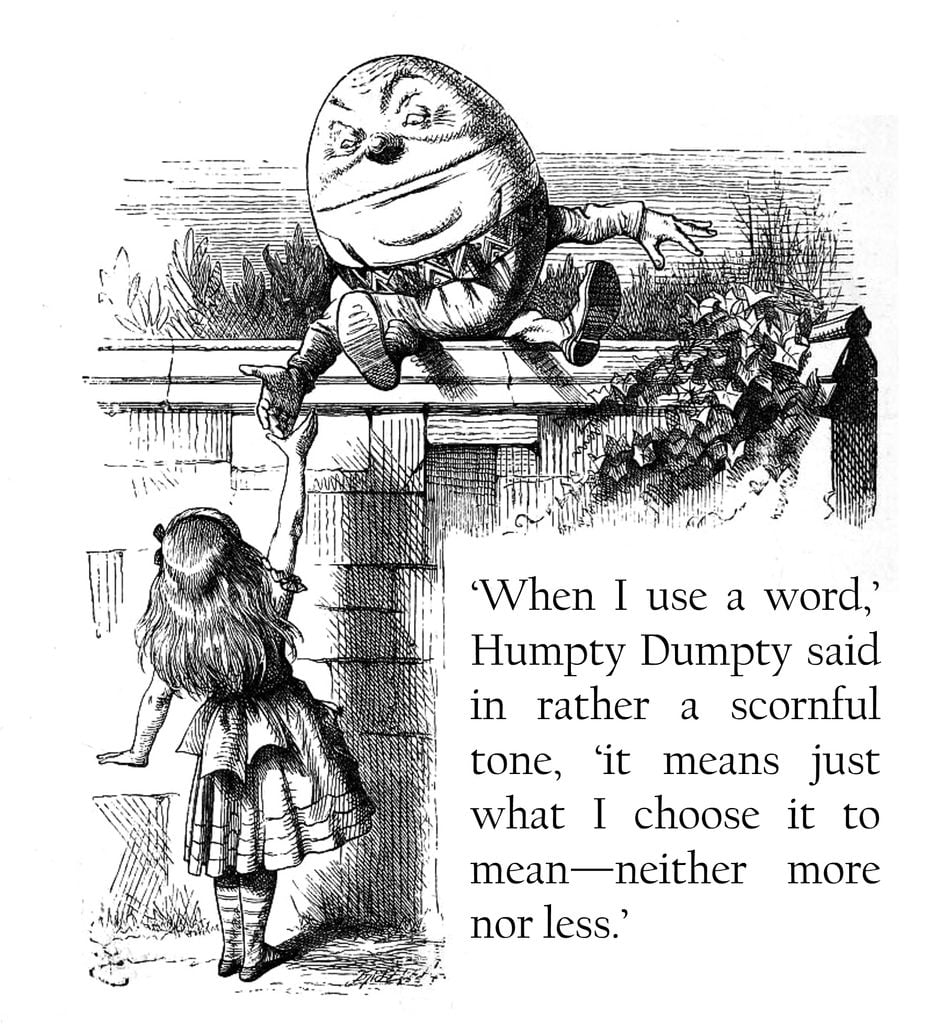
One might be tempted to say we are quickly moving Through the Looking Glass. Here’s an exchange between Alice and Humpty Dumpty from Lewis Carroll’s novel of inversions. Humpty Dumpty is a haughty character who is, as one might guess, sitting on a wall:
‘When I use a word,’ Humpty Dumpty said in rather a scornful tone, ‘it means just what I choose it to mean—neither more nor less.’ ‘The question is,’ said Alice, ‘whether you can make words mean so many different things.’ ‘The question is,’ said Humpty Dumpty, ‘which is to be master—that’s all.’
Humpty Dumpty, as we all know, had a terrific fall from his high and haughty wall. One might even imagine that Carroll puts these arrogant words into Humpty’s mouth as an explanation for the ensuing collapse.
It is not merely eggs on high walls that the president’s speech brings to mind. Consider the story of Nebuchadnezzar, king of Babylon who had a troubling dream. The Hebrew prophet Daniel was brought in to interpret it. In the dream, a tree grew and “its top reached to heaven, and it was visible to the end of the whole earth.” The dream was a warning of coming judgment, for Nebuchadnezzar imagined himself without peer on earth or in heaven. In his pride he refused to heed the warning.
Some time later, Nebuchadnezzar was strolling on the roof of his palace—like Humpty Dumpty, he was high on a wall—admiring himself and his handiwork. He said to himself: “Is not this great Babylon, which I have built by my mighty power as a royal residence and for the glory of my majesty?” While those proud words were “still in the king’s mouth” a voice “from heaven” declared judgment on the king and his hubris: “The kingdom has departed from you, and you shall be driven from among men, and your dwelling shall be with the beasts of the field.” The mighty king was brought low and became like a beast. He remained in this sub-human state until he acknowledged One greater than himself: “I lifted my eyes to heaven, and my reason returned to me, and I blessed the Most High.”
Nebuchadnezzar’s punishment was the loss of his reason; which is to say, he lost access to language—the logos—by which intelligible communication is made possible and by which human communities are made functional.