DG Hart’s new book Independence Hall: History of an American lcon reviewed by Law and Liberty.
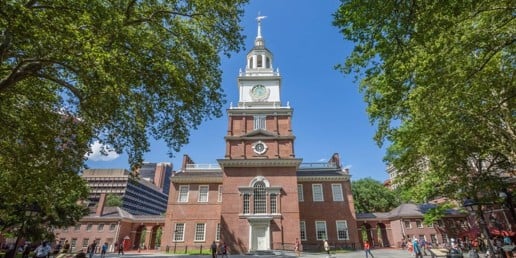
When Jeffrey Rosen was the president and CEO of the National Constitution Center in Philadelphia, he would open events in the Center’s stunning Great Hall Overlook by asking the audience to pause and look out the windows. There, across stretches of park lawn, stands Independence Hall. That’s where Washington was sent out to lead the revolution. That’s where the founding documents were debated and signed. That is where the nation began. And the building is still there for us to see.
Perhaps we take that for granted, and perhaps that’s why it is such a remarkable thing to look out the windows at Independence Hall, and to really take in the sight. It is exceptional for any building from the eighteenth century to still be standing, but Independence Hall remains.
Now D. G. Hart has written a history of Independence Hall that teaches us not only what happened there but also how subsequent generations tried to remember it. Despite the imperfections of memory, those walls still stand and serve as a reminder, aided now by Hart, of “the course of human events” that transpired there.
Some of those events are famous, and others should become so. For example, Benjamin Franklin’s role in the Second Continental Congress and the Constitutional Convention is widely celebrated. Less known is the fact that he served as the clerk of the Pennsylvania General Assembly beginning in 1736, just as the assembly began meeting in the building that would later be called Independence Hall. Franklin spent decades of his life making institutions in Independence Hall in one way or another. Also beginning in 1736, Franklin’s Library Company made use of space at Independence Hall, where it continued to keep books until 1773. And after Franklin co-founded the American Philosophical Society in 1743, the scientific organization convened many of its meetings at Independence Hall. As Hart puts it, “Without the State House, Ben Franklin would not have become who he was, and without Ben Franklin, Pennsylvania’s capital would not have become home to the American founding.”
So Independence Hall was a site of colonial governance and civil society before it became the essential place of American independence and the Founding. And in an era before easy access to watches, the clocks and bell of Independence Hall served as “a common reference for meetings, appointments, and opening shops.”
When the Declaration of Independence emerged from Independence Hall in 1776, it too was a kind of common reference point for Americans, and eventually for free people everywhere.