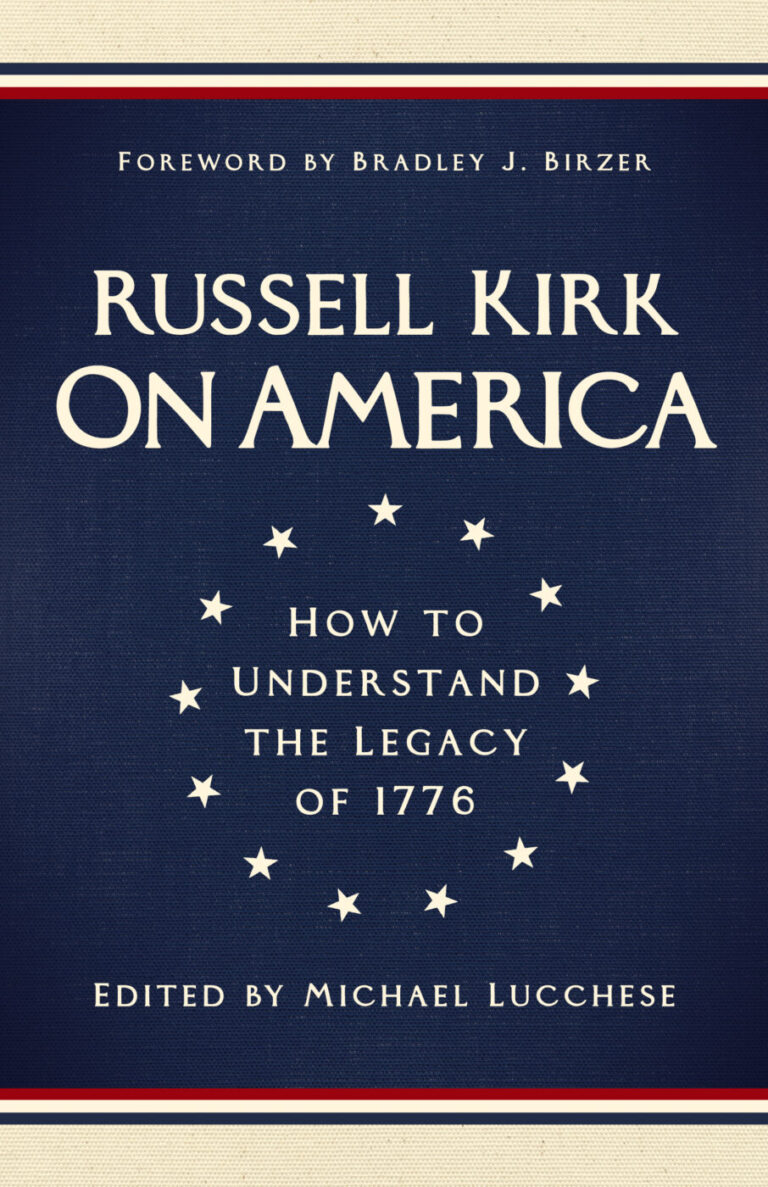
On America by Russell Kirk is reviewed by Ferenc Hörcher in Engelsberg Ideas.
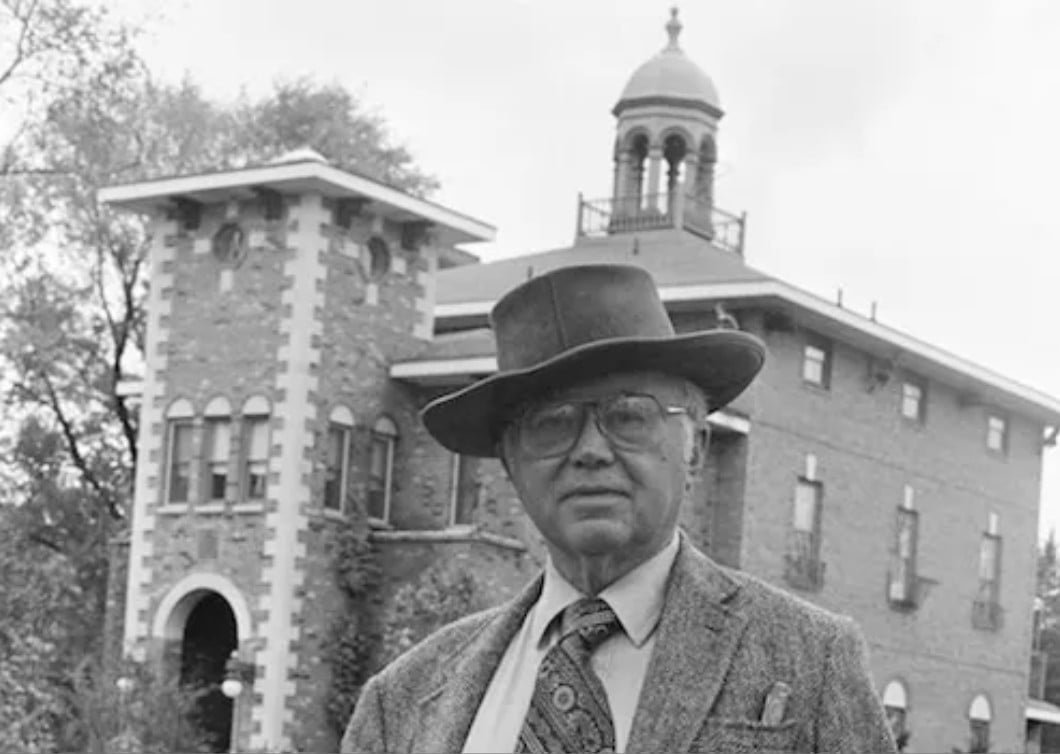
Russell Kirk was an exceptional kind of conservative intellectual, talented and blessed with a practical bent, who revealed the poetic sensibility that inspired some of America’s greatest political figures.
This collection of essays, edited by Michael Lucchese, published to celebrate the 250th anniversary of the Declaration of Independence, has the obvious aim to introduce Russell Kirk’s ideas about the fundamentals of American politics. Yet it achieves more than that: it also provides a great insight into Kirk’s general ideas of politics as part of cultured human cohabitation.
Russell Kirk was an exceptional kind of conservative intellectual: he had both a talent for deep intellectual work on politics, but also a practical bent, an ability to find his way both to the general public, but also to the powerful, in order to try to make his own theoretical work useful. While most conservative intellectuals are intellectuals in the sense of being unable to enter the world of practical politics, for Kirk intellectual work was not a substitute for politics. Rather, it was his contribution to politics.
In the final, summarising essay of the volume, entitled ‘On America’, Kirk presents in a rather refined manner an astonishing, unconventional connection between two ancient forms of activity – poetry and politics. Edmund Burke appears as a hero of both of these realms: ‘at once the most imaginative and most practical of writers and doers in our political tradition of the English-speaking people’. It is exactly because of this two-fold nature of Burke’s talent that Kirk admired him as the most reliable guide on the troubled waters of politics.
Why is this duality so important? An obvious response would be that poets, as we know them in (post-)modernity, are not by nature political animals, and most politicians have no poetic sensibility. Yet this is exactly the specific requirement Kirk identifies as the distinguishing mark of the promising character of a right-wing politician.
Interestingly enough, he sets out to support and substantiate his argument regarding the relationship between poetry and politics in an essay about President Ronald Reagan. The argument is that audacity is a requirement of true statesmanship, as, in the Postmodern Age, it is ‘a weapon reserved for the friends of order and justice and freedom’. Yet without ‘the poetic imagination’ it is not available.