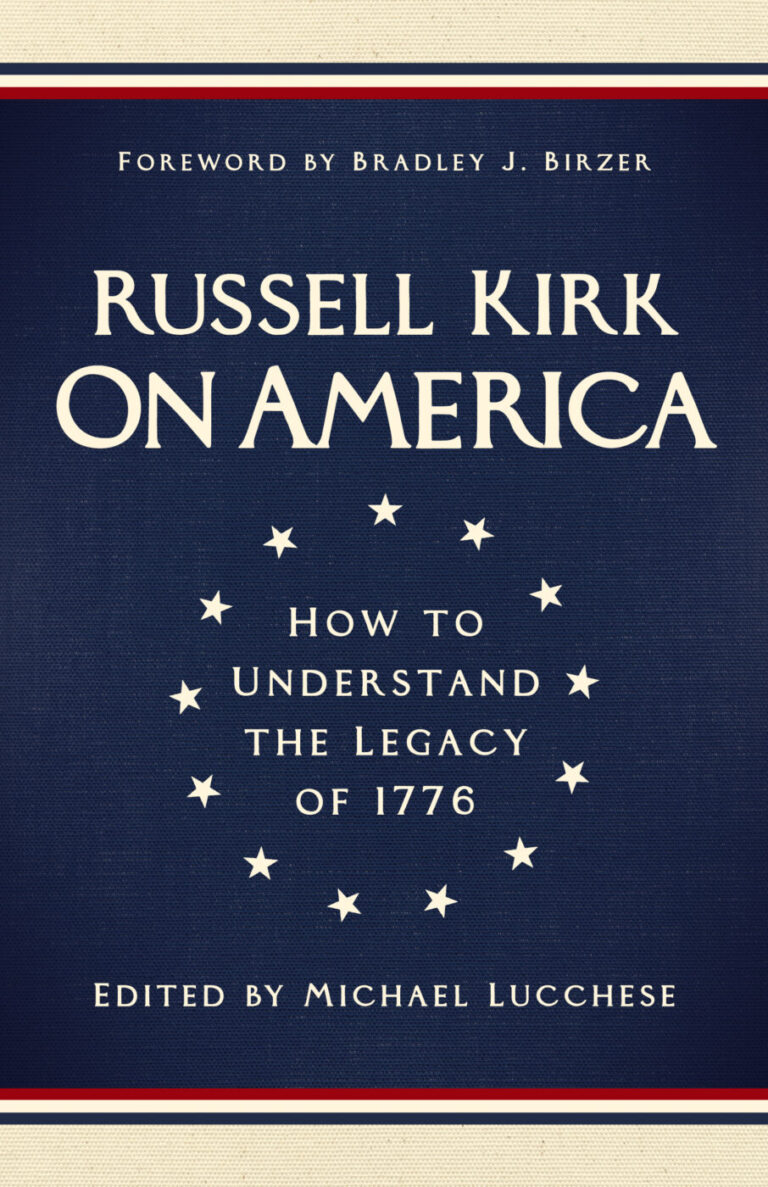
On America by Russell Kirk is reviewed by Bradley J. Birzer in The Imaginative Conservative

In his new book, Michael Lucchese shows us that Russell Kirk believed that America—in world history and in God’s providence—served as a Platonic anamnesis, a thing that forces us to remember what is eternal, good, true, and beautiful, through right reason in the very womb of time itself.
Ave, Michael Lucchese!
All of us at The Imaginative Conservative are more than familiar with the work of Dr. Russell Amos Kirk (1918-1994), the founder of post-war conservatism. He is the guiding light of TIC, and we exist, in many ways, to promote as well as expand upon his thought on a multitude of things from literature to liturgy.
Lucchese’s name is not quite as well known as Kirk’s, but, someday, it will be. Lucchese is not only his generation’s Kirk, but he’s also the very future of conservatism. His latest book, an edited collection with a beautiful introductory essay by the author, Russell Kirk on America: How to Understand the Legacy of 1776 (Creed and Culture Books), is not merely just one new book in a long line of books to be published in the summer of 2026, it is an event, in and of itself.
Physically, the book is a thing to behold—well bound on high-quality paper and with a gorgeous page layout. The book has heft. The press, Creed and Culture, is especially to be commended for this epicurean gift.
But, it is the insides, the very soul of the book, that matters most. And, Lucchese has brilliantly channeled Kirk on the most important non-religious subject of this year: America as she quickly approaches her 250th birthday. Lucchese has pulled together Kirk’s various writings on America, with topics ranging from the meaning of the Declaration of Independence and the Constitution, to the republican significance of Abraham Lincoln and Ronald Reagan, to the letters of Nathaniel Hawthrone and Mark Twain. Lucchese has expertly drawn these various writings from unpublished speeches, book chapters, and published articles, often difficult to find.
Not just the founder of post-war Conservatism, Kirk was also an American original, the most individual of non-individualists, and he was one of the greatest commentators to assess America, her character, and her legacy.
What exactly was America to Kirk? Taking many of his ideas from the Austrian philosopher Eric Voegelin, Kirk believed that America—in world history and in God’s providence—served as a Platonic anamnesis, a thing that forces us to remember what is eternal, good, true, and beautiful, through right reason in the very womb of time itself.