An Excerpt from Jesus, The Man Who Lives.

We are excited to release a special 50th Anniversary Edition of Jesus, the Man Who Lives, by Malcolm Muggeridge, one of the most arrestingly insightful reflections ever written on the life, person, and teachings of Christ. Just in time for the Easter Season, the celebrated British author and journalist, Malcolm Muggeridge offers a meditation that was deemed by The London Times to be his “masterpiece, the greatest achievement of his life as a writer.” With insights born from his own conversion, Muggeridge’s portrait of Christ is at once deeply personal and universally accessible.
In this excerpt, Muggeridge opines on the meaning of the Last Supper, not as a theologian (though his words are full of theological insight), but as man drawn into a mystery.
- Jesus, The Man Who Lives pp.167-172 (Available for Pre-Order Here)
This was to be, he knew, his last Passover; the last occasion on which, as a mortal man, he would participate in an act of worship and thankfulness with his disciples, who were, after all, very dear to him. The Passover itself symbolized a release—of the Children of Israel from Egypt; it, too, was supposed to be celebrated in a state of readiness to depart, just as he had told the disciples to live in readiness for his return, with all their earthly ties and commitments wound up, so that they could depart at a moment’s notice. Thus, the old Jewish feast was entirely appropriate for the new Christian feast; the one became the other, comprehending both.
In the story of Jesus this celebration of what came to be called the Last Supper, in which the old Passover is transmuted into the new Eucharist,
is one of the great climaxes, along with the Nativity, the Baptism, the Crucifixion, and the Resurrection, and as such has been portrayed in innumerable ways through the centuries of Christendom, in words and music and paint and marble and stone—in every representational medium known or devised.
According to the Gospels’ account, the celebration took place in an upper room put at Jesus’s disposition for the purpose the same sort of way as was the ass on which he rode into Jerusalem. Peter and John were instructed—it is perhaps significant that it was they, rather than Judas, who would normally be in charge of such arrangements—to go into Jerusalem, and when they saw a man carrying a pitcher of water they were to follow him into the house he was making for. There they were to say to the good man of the house: Where is the guest chamber where I shall eat the Passover with my disciples? They would thereupon be shown a larger furnished upper room, in which they were to make all necessary preparations.
It is usually suggested that in the case both of the ass and the upper room, the donors were people with whom Jesus had quasi-clandestine contacts. Though the matter is of little importance, it would seem to me that in the drama of Jesus’s last days and hours the circumstances for it shaped themselves; so powerful a script, as it were, producing its own props and extras. In the same sort of way, a sleepwalker never stumbles or falters; the skull is ready to Hamlet’s hand, Socrates does not need to call for his hemlock, nor the serpent in the Garden of Eden to hunt for an apple. The traditional scene is a long table with Jesus in the middle and the disciples ranged on either side of him, with John, described as the disciple he loved, next to him. In the Roman style, they recline on couches. Probably, it was something a good deal more primitive; they were poor men with simple ways, especially the fishermen, whose like are to be seen today in Asia Minor eating their meals—a hunk of bread and a newly caught fish; the selfsame food distributed to the five thousand—amidst their nets and boats.
Jesus tells the disciples of his great desire to have this Passover with them, knowing that his hour was come that he should depart out of this world unto the Father, having loved his own which were in the world, he loved them unto tenthly still only vaguely understand what he is getting at. He has one last practical lesson for them, and to demonstrate it, takes off his outer garments, puts a towel round himself, and goes from one to the other—including Judas—to wash their feet; first wetting them, and then wiping them with the towel. This done, he puts on his clothes again, resumes his place at the table, and explains the significance of his action.
They call him Master, and rightly so, but in washing their feet the Master deliberately abases himself in order to demonstrate that great-ness lies, not in self-assertion, but in self-abnegation. Earthly authority displays itself in giving orders, in magnificent apparel, condition of all virtue, and that in abasing themselves, men attain the highest heights, as, in glorifying themselves, they sink to the lowest depths.
One of Jesus’s greatest gifts was to release a tidal wave of humility, flowing through the world against the Devil’s contrary tide of self-assertion—the Devil being the great I Am, and Jesus the great We Are.
Thanks to this, the laughter of the saints has drowned the trumpets of the great; the nakedness of the saints mocked the splendor of captains and kings; the foolishness of the saints confuted the wit and wisdom of the learned. Every court has its Fool, and the Fool is Jesus. If the greatest of all, Incarnate God, chooses to be the servant of all, who will wish to be the master? If he receives orders, who will venture to give them? If those who climb are descending, and those who descend, climbing, who will aspire after eminence? These are the questions Jesus leaves with us; not to answer—because they have no answer—but to live with and by.
Christianity is a stupendous riddle without a solution; a stupendous joke without a point; a stupendous song without a tune; a stupendous waking dream that we lose in sleeping; death in life and a life in death. The Passover begins with breaking bread; something that in itself is very beautiful at all times as signifying the sharing of food, our body’s first necessity, with one another. When bread is broken, it is made available; and, in a company, each taking a piece unites them as, before being broken, the bread was united. So, its breaking is an assurance that the participants are brothers and cannot harm one another. This is the most ancient of all sacraments. Jesus, however, on the occasion of his last Passover, went further, and when he had broken the bread and given it to his disciples—still including Judas—he added the mysterious words: This is my body which is given for you: this do in remembrance of me. In like manner he took the cup, saying, This . . . is the New Testament in my blood, which is shed for you.
He had spoken in this sort of strain before. For instance, when he told the woman of Samaria that he could give her living water, and that, after drinking it, she would never thirst again. It was water that would become, for whoever drank it, a well . . . springing up into everlasting life. Or when in Galilee he spoke of being the bread of life. This was not, he said, like the manna in the wilderness, which the Children of Israel ate, but which did not prevent them from dying. It was living bread, which also came down from Heaven and if any man eat of this bread, he shall live forever: and the bread that I will give is my flesh, which I will give for the life of the world. Later, in the synagogue in Capernaum, according to the Fourth Gospel, he was even more explicit: Except ye eat the flesh of the Son of man, and drink his blood, ye have no life in you. . . . For my flesh is meat indeed, and my blood is drink indeed. He that eateth my flesh, and drinketh my blood, dwelleth in me, and I in him. As the living Father hath sent me, and I live by the Father: so he that eateth me, even he shall live by me.
At the Last Supper this notion of Jesus’s flesh and blood becoming not just, like manna, sustenance now, the food of Time, but everlasting sustenance, food for Eternity—this mysterious notion was made actual.
His flesh was veritably handed out in morsels of bread, his blood in a cup of wine. The twelve, Judas included, ate him and drank him, in a celebration which was to provide the early Church with its basic act of worship; already being practiced in the time of the Apostle Paul, and continuing in one form or another to the present day, so that through the past twenty centuries there has certainly never been a week, maybe never a day or an hour even, when someone somewhere was not dispensing the body and blood of Jesus, or at any rate recalling that Last Supper in Jerusalem and Jesus’s words at it by munching a morsel of bread and swallowing a sip of wine.
So many variations in procedure, but always the same essential theme of a man offering his physical existence, his flesh and blood, in order that other men might know and experience a spiritual existence which was everlasting.
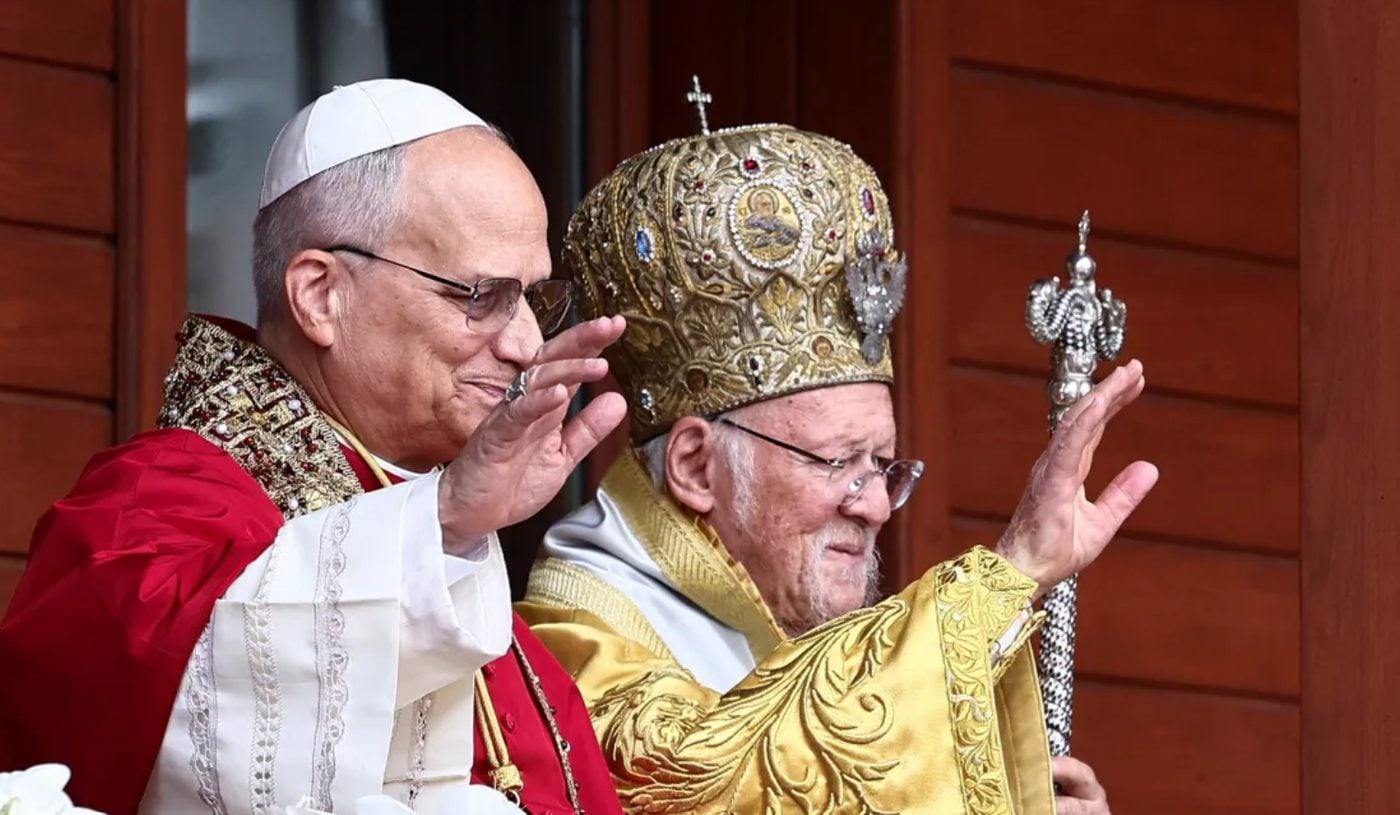
Thus, a Pope in majestic vestments intones the words—Take, eat; this is my body. . . . Drink ye all of [this]; for this is my blood—at his High Altar in St. Peter’s, its cavernous space overflowing with accompanying music which expresses the same mystical joy in the sacrifice of Calvary, in the Lamb of God that takes away the sins of the world. Thus, too, in his own austere style, a stern Presbyterian minister in a black gown with stony reverence offers bread and unfermented wine to his flock in remembrance of that gathering in Jerusalem when Jesus made his final dispositions before submitting himself to the laws of men and the Cross. Innumerable variations in the commemoration, but always the same event and the same words recalled.
The worshippers wait at the altar rails, like famished dossers at a soup-kitchen, their mouths open, their hands outspread; then return to their places visibly revived.
“Hereux les invités aure pas du Seigneur! Voici l’Agneau de Dieu qui enlève le pechedu monde, ”the priest says in the French Mass as he dispenses the consecrated bread, Le Corps du Christ. Happy, indeed, the guests at this feast, but I, alas, have never been among them, nor most probably ever will be. Sadly, I have to admit that its sublime symbolism has always eluded me. The magic of transubstantiation fails to work; the wafer and the wine fall on my tongue as wafer and wine, and are swallowed, if at all, as such. For me, only the Fearful Symmetry of life itself has seemed truly convincing; all secondary versions or simulations—such as a monarch elaborately anointed to be a symbolic Head of State, a military tattoo to convey a battle, porn for passion or celluloid for flesh—are ultimately untenable. Similarly, with the bread-flesh and the wine-blood. Was this, I ask myself, what sent Judas out into the night to betray his Master?—that the bread and wine remained for him, as for me, untransubstantiated, the Presence unreal?