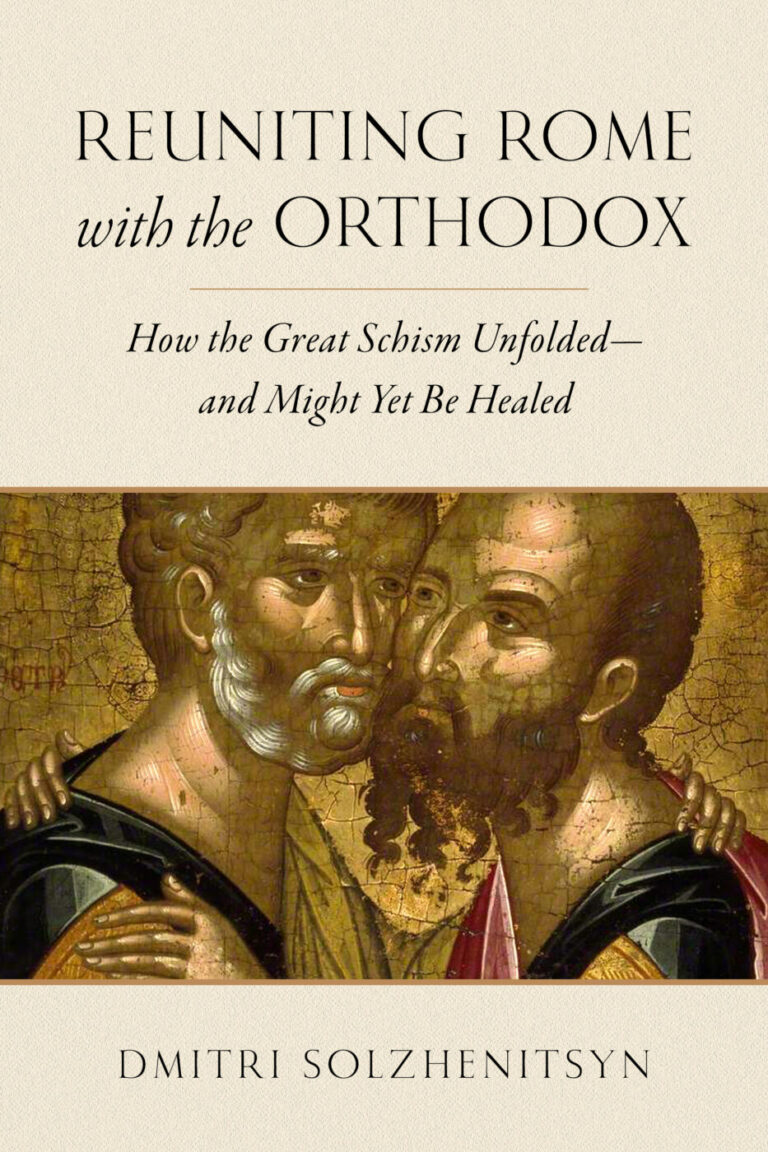
An excerpt in The Catholic Herald from Dmitri Solzhenitsyn’s forthcoming book Uniting Rome with the Orthodox .
In recent decades, the prospect of Catholic–Eastern Orthodox reunification has increasingly captured the attention of theologians, hierarchs and the faithful alike. As champions of unity continue to address longstanding theological and attitudinal barriers (many of which I explore in my upcoming book Reuniting Rome with the Orthodox, from which the below is excerpted) one must remember that individual personalities have also shaped the course of ecclesial history – sometimes with lasting consequences.
A particularly striking instance unfolded in 1054 when Cardinal Humbert of Silva Candida, the papal legate, confronted Patriarch Michael Cerularius in Constantinople. Humbert entered Hagia Sophia and, disregarding both the pleas of the clergy present and his initial mandate from Pope Leo IX, laid a bull of excommunication upon the altar before withdrawing from the imperial city. This episode was hardly an isolated case: the decisions and temperaments of individual churchmen have altered the course of ecclesial relations at numerous other junctures throughout the history of Christianity.
Accordingly, no analysis of the modern Catholic-Orthodox landscape would be complete without considering the person of Pope Leo XIV. One burning question for reunification created by the relatively recent change of Pope is the following: will Pope Leo continue the modern Roman Church’s conciliar and conciliatory tendencies?
The answer, in all likelihood, is yes. Slightly over a year into Pope Leo’s pontificate, he has already endorsed a humble reading of the Petrine text and indicated that his office will be one of diakonia: “If the rock is Christ, Peter must shepherd the flock without ever yielding to the temptation to be an autocrat, lording it over those entrusted to him.” Instead, “he is called to serve the faith of his brothers and sisters, and to walk alongside them.”
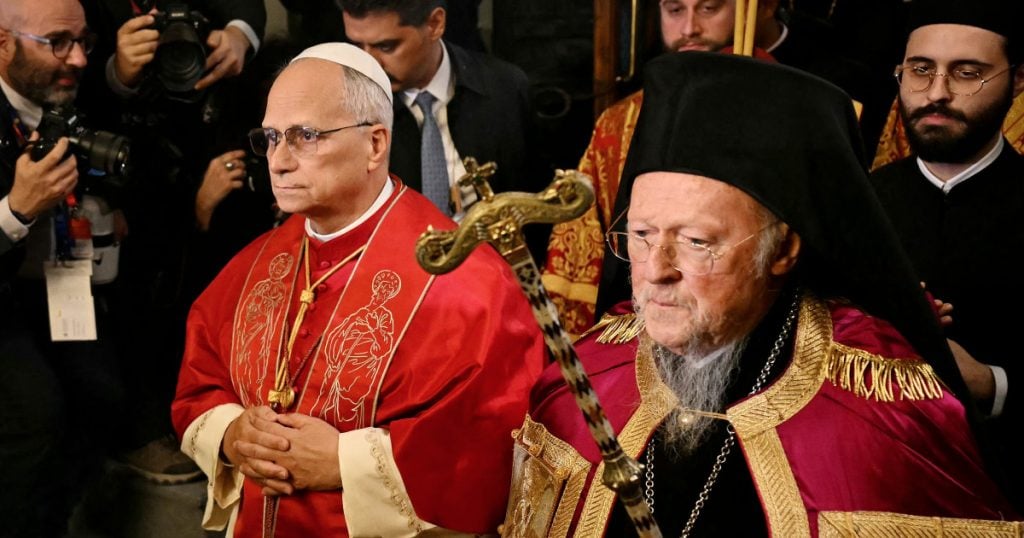
As for Pope Leo’s relations with the Orthodox, they are off to a positive start. Patriarch Bartholomew has already met several times with the Pontiff, and the pair have reportedly struck a “friendly and cordial” note. In late 2025, Pope Leo celebrated the 1,700th anniversary of the Council of Nicaea with Patriarch Bartholomew, Patriarch Theodore II of Alexandria and other Orthodox patriarchal representatives in Turkey (though the absence of Moscow – which appears neither to have been invited nor to have been interested in attending – was conspicuous). Leo’s visit fulfilled Pope Francis’s wish that his successor mark the occasion there in the event of his death.
As part of the days-long celebration, Pope Leo and Patriarch Bartholomew issued a joint declaration affirming their Churches’ orientation “towards the hoped-for restoration of full communion between our sister Churches” and calling on the “clergy, monastics, consecrated persons, and the lay faithful” to observe Christ’s call for unity. The declaration further exhorted “those who are still hesitant to any form of dialogue, to listen to what the Spirit says to the Churches… [urging] us to present to the world a renewed witness of peace, reconciliation and unity.”