An essay adapted from the preface to Patrick J. Deneen’s new book, American Odyssey.
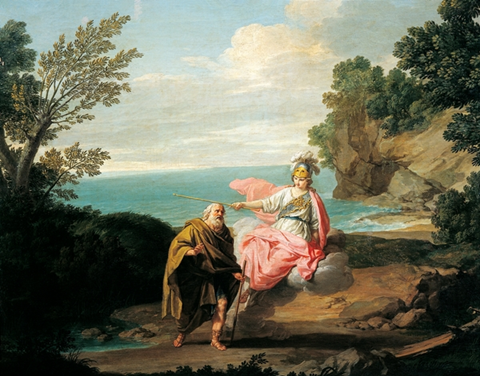
On July 4, 2026, Americans celebrated the 250th anniversary of the Declaration of Independence. Two weeks later, droves of moviegoers were immersed in a cinematic rendition of one of the foundational stories of the Western tradition, the Odyssey. That these two events—the observance of the American semiquincentennial and the premiere of a silver-screen version of Homer’s great epic—should follow one another in such short order was, of course, a coincidence. Yet the juxtaposition of these disparate events gives us an opportunity to note and explore the deep connections between them.
et us begin by recalling the origins of the Declaration. That the celebration of Independence Day—in 2026 as in years previous—would be marked by fireworks, parades, picnics, and family and communal gatherings was predicted by John Adams, even if he was off by two days in marking the date:
The Second Day of July 1776, will be the most memorable Epoch in the History of America. I am apt to believe that it will be celebrated, by succeeding Generations, as the great anniversary Festival. It ought to be commemorated, as the Day of Deliverance by solemn Acts of Devotion to God Almighty. It ought to be solemnized with Pomp and Parade, with Shews, Games, Sports, Guns, Bells, Bonfires and Illuminations from one End of this Continent to the other from this Time forward forever more.
In addition to many “shews, games, sports, guns, bells, bonfires, and illuminations,” the 250th commemoration of Independence Day provided an apposite occasion for reflection on the meaning and legacy of the American Founding, especially the philosophy expressed in the Declaration. That philosophy, it has been widely agreed and celebrated, was generally liberal and modeled in broad strokes on the political philosophy articulated by the English philosopher John Locke in his Second Treatise of Government (1690).
In that work, Locke rejected the longstanding form of political rule that had predominated in Europe throughout much of its history, in which rulers were designated based upon inherited status. According to Locke, such rule was illegitimate because it circumvented the consent of the governed. It therefore lent itself to various forms of self-serving despotism perpetrated by a perpetual aristocracy. Locke argued that genuine political legitimacy could only be achieved when people consented to a government that existed solely to secure individual natural rights. Such rights, he believed, preexisted politics. They are part of the natural inheritance of human beings, possessions with which they are “endowed by their Creator.” While Locke identified these rights repeatedly as “life, liberty, and estate [property],” the authors of the Declaration would famously alter the third term in that trinity to read “the pursuit of happiness.”