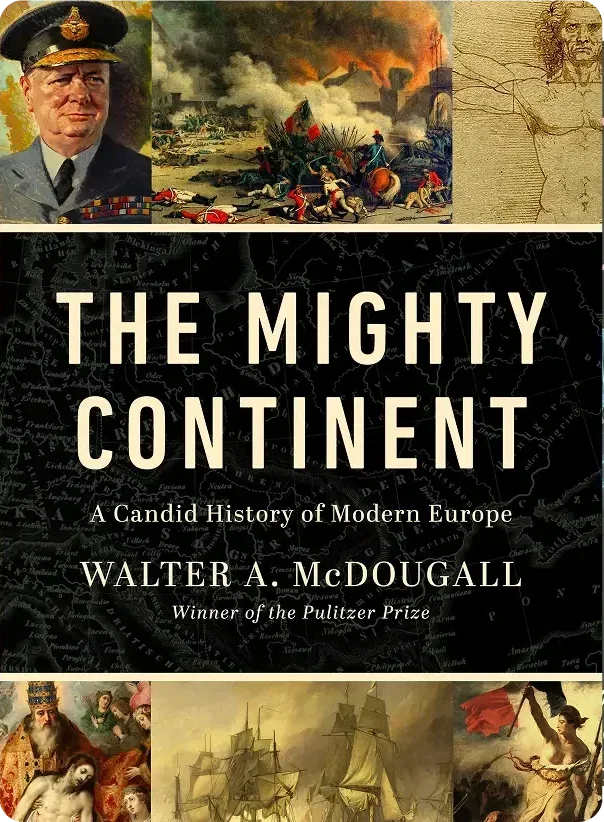
An excerpt from The Mighty Continent, by Walter A. McDougall

Toward the end of the fifteenth century, at the height of the Renaissance and just twenty years before Martin Luther inspired the Reformation, Europeans began to sail all over the globe. So it was that what historians call early modern history began.
The relative isolation of the world’s civilizations from each other could not last forever. Sooner or later, one of them was certain to learn the techniques of oceanic navigation and spill their explorers, merchants, soldiers, and missionaries onto other continents, each with their own cultures. The ensuing clashes of civilizations were bound to have a traumatic impact.
Nowadays political correctness requires people of European descent to display shame over their ancestors’ treatment of the non-Western peoples they encountered. But the interesting question about the Age of Discovery is not whether da Gama, Columbus, and other European explorers were audacious, brutal, or greedy. Being human, they were all the above. No, the truly interesting questions are these: Why was it Europeans who began ceaselessly to explore every corner of the world? And why did that explosive era of exploration occur when it did?
That it would be Europeans who took the lead in global exploration was not inevitable. For instance, did Europeans command more sophisticated technology than other cultures around the year 1500? No! Europe was then catching up with the science and technology of some Asian civilizations, and many of the inventions that propelled European expansion—such as the magnetic compass, gunpowder, mathematics, and celestial navigation—were imported from the Chinese, Turks, Arabs, and Hindus. Had Europeans forged stronger, more unified empires than people elsewhere in the world? No! The kingdoms of Renaissance Europe were constantly at war with each other.
Were Europeans even the first to venture onto the high seas in search of new worlds? No again! Between 1405 and 1433, Chinese Admiral Zheng He led majestic fleets of treasure ships on voyages through the Strait of Malacca and Indian Ocean, and perhaps as far as the coast of Africa, to trade and collect tribute. Had these “Ming Voyages” continued, Asians might have discovered sea routes to Europe instead of the other way around. But the Ming dynasty’s all-powerful emperors ordered the voyages stopped for three reasons: first, because Confucian ethics denigrated commerce as a legitimate human pursuit; second, because the merchants of southern China were of dubious loyalty to the emperor, who was based far to the north in Beijing; and third, because the principal threat to Chinese security was posed by barbarians on the northern frontier, making it more strategic for the empire to invest in land rather than sea power. Then, too, the Chinese considered their Middle Kingdom the only true civilization on earth and had little curiosity about distant barbarians.
Things were different in Europe. For one thing, no one there—no pope, no king, no emperor—possessed the power or authority to shut down exploration. If there was advantage to be had in seeking out new trading routes, some state or private company was sure to pursue it, and once exploration proved to be profitable, rival rulers and companies were sure to follow. In short, Europe’s very disunity was a great source of strength. It bestowed a competitive freedom virtually unknown elsewhere.
Consider the Arabs, who were also avid traders, and whose Muslim religion was also evangelical. By 1400 the Arabs were ruled by the Ottoman Turkish Sultan, who gathered all political and religious authority to himself. Moreover, the Ottoman Turks were a caste of warlike people who, like the Chinese mandarins, considered money-grubbing commerce beneath them. None of that was the case in Europe, where divided authority and competition encouraged quests for new knowledge and opportunity, and where the Renaissance faith in progress validated the pursuit of power and wealth.
Finally, Europeans displayed a unique curiosity about other cultures. While they believed in the truth of their Christian religion, they did not conclude from that conviction that they had nothing to learn from encounters with other places and peoples. On the contrary, Europeans were voraciously interested in any practical knowledge that would serve their material interests.
That Europeans’ motives were various and, morally speaking, less than pris tine hardly made them exceptional. Why else do peoples seek contact with alien others except to plunder them, trade with them, study them, conquer them, or convert them? What made Europe exceptional lay in its means, not its motives, which brings us back to techne. Fascination with the physical world and its laws of nature; eagerness to borrow and improve on the tools and ideas developed by others; boundless self-confidence and willingness to take outrageous risks in hopes of acquiring honor, glory, power, and wealth in the service of church, state, and self—during the late medieval and Renaissance eras such qualities were on bold display in Europeans’ innovative shipbuilding, sail rigging, rudders, navigation, mapping, cannons, and muskets. Most striking, perhaps, was the sheer fortitude of the Portuguese and Spanish captains and sailors, plus the Italians in their service, who dared to sail beyond the sight of land in faith that their skill, good fortune, and divine protection would bring them to safe harbors somewhere out there in the vast unknown.
No ocean-plying ships—no Portuguese caravels, Spanish galleons, or Dutch fluyts—would have been built at all unless people had been willing to finance expensive and risky voyages. Two sorts of Europeans were willing to do so by the late 1400s: rich merchants who pooled their money to spread and mitigate risk and state-building monarchs able to acquire the necessary capital via taxation or borrowing, and thus able to fund what amounted to the research and development of that era.
The first monarch to promote exploration was Portugal’s Prince Henry the Navigator (1394–1460). At his court he assembled the best astronomers, navigators, and shipwrights and dispatched expeditions that discovered the Azores and Madeira Islands and planted forts on the west African coast to protect trade with the Arabs. Henry reinvested his profits in such efforts. He also borrowed large sums (he would die deep in debt) to finance more ambitious voyages aimed at finding a sea route around Africa. If he was successful, the Portuguese could outflank the Arab, Turkish, and Venetian middlemen who dominated the over land spice trade and capture immense profits for themselves.
Further and further down the torrid, disease-ridden west African coast Henry’s caravels sailed. Only sixty feet or so in length, these ships carried two or three masts and lateen-rigged sails. They were equipped with crude but effective rudders for steering. They were also the first European ships that did not require galley slaves to pull oars below deck in order to make headway whenever the wind was contrary. Although these vessels were sturdier than their predecessors, it was still frightening to sail into unknown waters beyond sight of land, often in stormy weather. One 1487 torrent blew a ship captained by Bartolomeu Dias clear around what he named the Cape of Storms at the African continent’s south ern tip. When the skies cleared he saw, to his amazement, that the coastline now lay to the west, rather than the east! He had entered a new sea: the Indian Ocean.
A decade later Vasco da Gama’s expedition crossed that ocean to Calicut on the Malabar Coast of India. The local authorities and merchants were hostile. One false move and the Europeans might never have made it home. But da Gama found a Jewish interpreter who knew both Arabic and Italian, and through him he negotiated for a cargo of spices that would yield a profit of six thousand percent back in Lisbon. That achievement bestowed on Portugal’s king a new epithet: Manuel Fortun ado (Manuel the Lucky). It also changed Portugal’s name for Africa’s southern coast from the Cape of Storms to the Cape of Good Hope.
The next time da Gama sailed for India, in 1502, he commanded a fleet of twenty-one ships. Soon thereafter the Duke of Albuquerque arrived with an even stronger fleet bearing soldiers who attacked strategic ports such as Goa. In a series of ferocious campaigns Albuquerque succeeded in capturing and fortifying the key choke points that controlled access to the Red Sea, Persian Gulf, and Straits of Malacca in the Spice Islands. From there Portuguese merchants and Jesuit missionaries such as St. Francis Xavier reconnoitered Asian coasts as far afield as China and the mysterious islands that they called Cipangu but that inhabitants called Nippon: Japan.
By 1515, the year of Albuquerque’s death, little Portugal had forged a thalassocracy—a maritime empire—that began to transform the global economy. Previously, the Arabs, Turks, and Venetians had served as middlemen for the spice trade, but now the Portuguese had outflanked them. For the city-states of Renaissance Italy, the result was a financial calamity as devastating as the military invasions that had begun in 1494. Henceforth, profits from spices, silks, tea, and porcelain flowed through Atlantic ports such as Lisbon, Seville, and, later on, Amsterdam, Antwerp, and London.
Meanwhile, in the year 1492 another expedition set out in search of a maritime route to Asia. How much did the Genoese captain Christopher Colom bus know about the western sea he proposed to cross? More than we used to think. . . .
— From Walter A. McDougall, The Mighty Continent: A Candid History of Modern Europe. (Available for preorder now; save 30% by subscribing to the Creed & Culture mailing list.)