Michael Lucchese examines the roots of our nation.
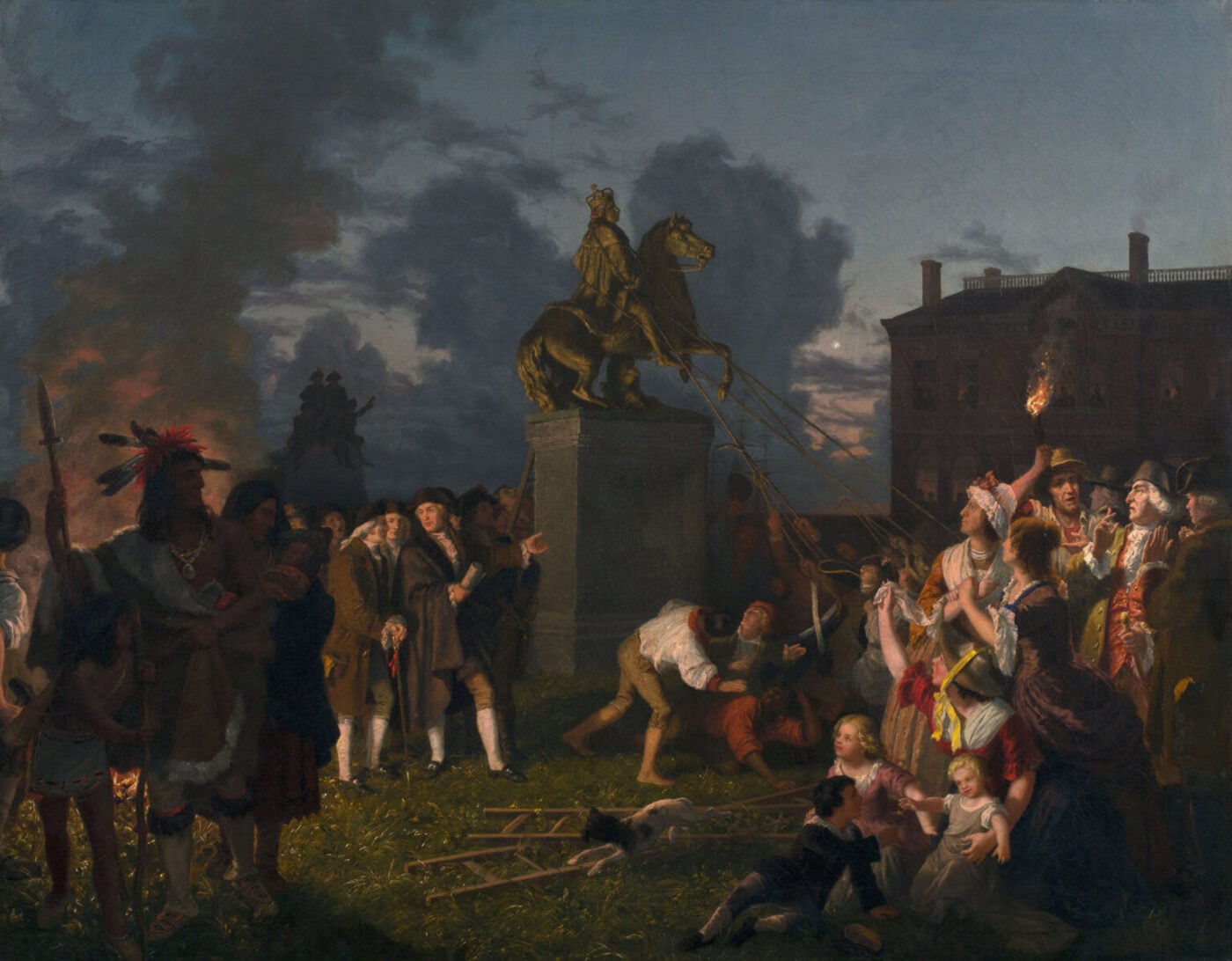
by Johannes Adam Simon Oertel
If the celebrations of this year’s semiquincentennial of independence are any indication, most Americans take pride in the revolutionary birth of our Republic. July 4, 1776, marked the birth of a “novus ordo seclorum,” and this nation seemed to have the power, as Thomas Paine wrote, “to begin the world over again.” Conservatives have always been somewhat ambivalent about those revolutionary beginnings. After all, conservatism emerged as a distinct philosophic position in reaction against the French Revolution, which was at least partly inspired, we must sadly admit, by events on this side of the Atlantic. How might thoughtful conservatives resolve the tension between counter-revolution and patriotism?
Certainly not by looking to the political Left. They accuse our Founders of hypocrisy or at least allege that they did not take their revolution far enough. This is old hat—the American franchisees of Jacobinism have been hurling this sort of invective since Thomas Jefferson returned from his mission to Paris. More surprising, perhaps, is that many on the Right are adopting increasingly revolutionary attitudes of their own. Some have called for “regime change” in favor of a “postliberal future,” or else declared that “conservatism is no longer enough.” Revolution (if not outright insurrection) is in the air. On both the Left and the Right, extremism is seen increasingly as a virtue and moderation as a vice. The limits of the Constitution are disparaged; politicos and theoreticians alike imagine new and more terrifying ways to deploy power against their enemies. The rage of parties does not seem to me likely to help us learn how to love our country or to justify the American Revolution.
John Adams—America’s foremost revolutionary statesman—warned about the perils of this sort of radical political situation. In a pamphlet he wrote in 1765 during the beginnings of the Imperial Crisis, A Dissertation on the Canon and Feudal Law, he urged his New England countrymen to adopt an ardent “spirit of liberty” and actively resist schemes from Parliament to destroy self-government and impose tyranny. But he also cautioned that this spirit could become little more than a “brutal rage” if left unenlightened. Adams and most of the Founders understood that revolution always poses serious dangers, and that it should always be a last resort.
And yet they also knew that there was a time for everything under the sun. “Prudence, indeed, will dictate that Governments long established should not be changed for light and transient causes,” the Continental Congress admitted in the Declaration of Independence itself. “But when a long train of abuses and usurpations, pursuing invariably the same Object evinces a design to reduce them under absolute Despotism, it is their right, it is their duty, to throw off such Government, and to provide new Guards for their future security.” The question is, how can we know when we have reached such a point of abuse? In our own time, we no doubt face any number of serious injustices. But would it be lawful to throw off our government and establish a new constitution? Does America need a revolution?
Strictly speaking, there can be no such thing as a positive legal right to revolution—certainly not for citizens of the United States. Though there have been various insurrections against federal authority throughout our history, only one came close to succeeding: the Southern Rebellion of 1861–65. Even as states were seceding to join the revolutionary Confederacy, Abraham Lincoln insisted that their actions were constitutionally null and void. “Plainly the central idea of secession is the essence of anarchy,” he wrote in his First Inaugural Address. Lincoln’s argument rested on what Publius called throughout The Federalist the “republican principle” of majority rule. “Whoever rejects it does of necessity fly to anarchy or to despotism,” Lincoln told the nation. “Unanimity is impossible. The rule of a minority, as a permanent arrangement, is wholly inadmissible; so that, rejecting the majority principle, anarchy or despotism in some form is all that is left.”